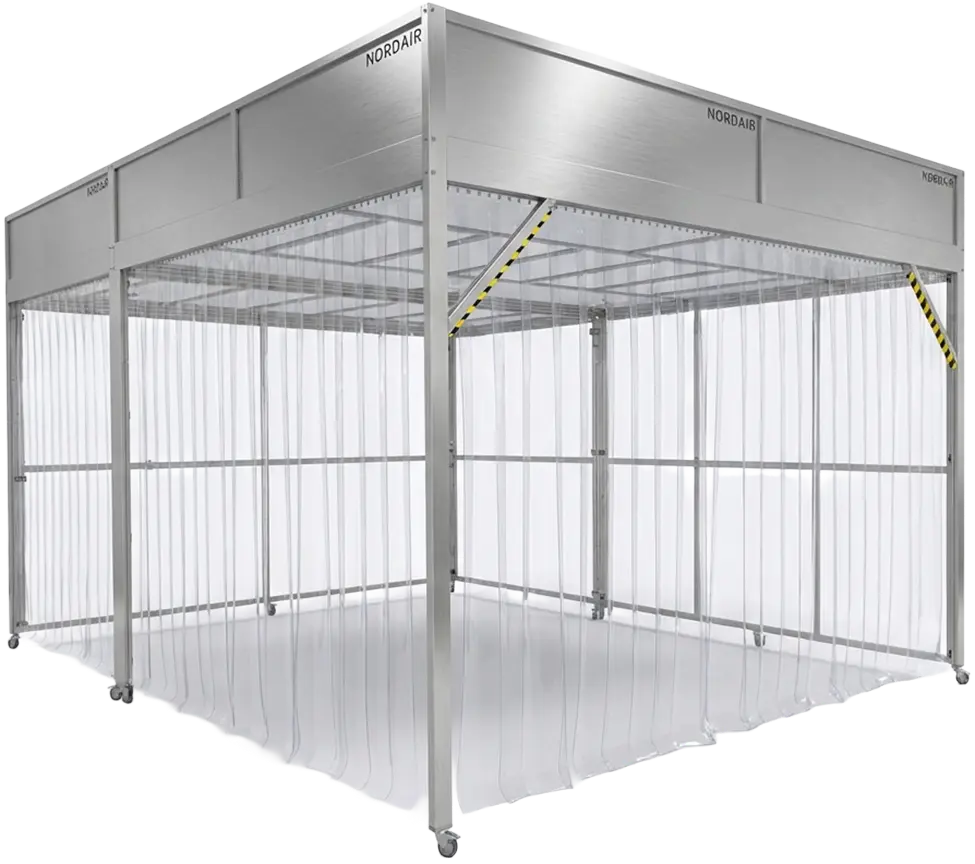
The purity of a cleanroom enlosure is determined by the filter class and the form of flow. By using HEPA H14 filters and laminar flow, the system reliably achieves the ISO class 5 in accordance with DIN EN ISO 14644-1, while permanent overpressure prevents external contamination from entering.
Filtration logic: H14 filter
The purity performance of a Nordair Systems cleanroom tent is defined physically by the degree of separation of the filter media. We install as standard HEPA H14 filters in accordance with DIN EN 1822. These filters have a separation efficiency of 99.995% with MPPS (Most Penetrating Particle Size, approx. 0.1—0.3 µm). This means that out of 100,000 particles, less than one single particle breaks through the filter. This is the technical basis for applications in semiconductor manufacturing or optical assembly. You can read more about the H14 filter here.
Fluid mechanics: laminar displacement flow
Purity is not static, but a dynamic balance of particle generation and removal. The Filter Fan Units (FFUs) generate a vertical airflow at a speed of approx. 0.45 m/s (± 20%). This so-called Laminar Flow acts like a sterile flask that displaces particles directly downwards from the working area (wash-down effect) before they can settle on sensitive surfaces. Turbulent mixed vents, such as those found in conventional air conditioning systems, simply stir up particles instead of removing them.
Zoning in accordance with ISO 14644-1
A cleanroom tent ensures the filters in the direct outflow area ISO class 5. This corresponds to a maximum of 3,520 particles (≥ 0.5 µm) per cubic meter of air. In the peripheral areas or when the filter load is reduced, there is typically a mixing purity of ISO 7 or ISO 8 in the entire room, while the critical process core remains ultra-clean under the filter.