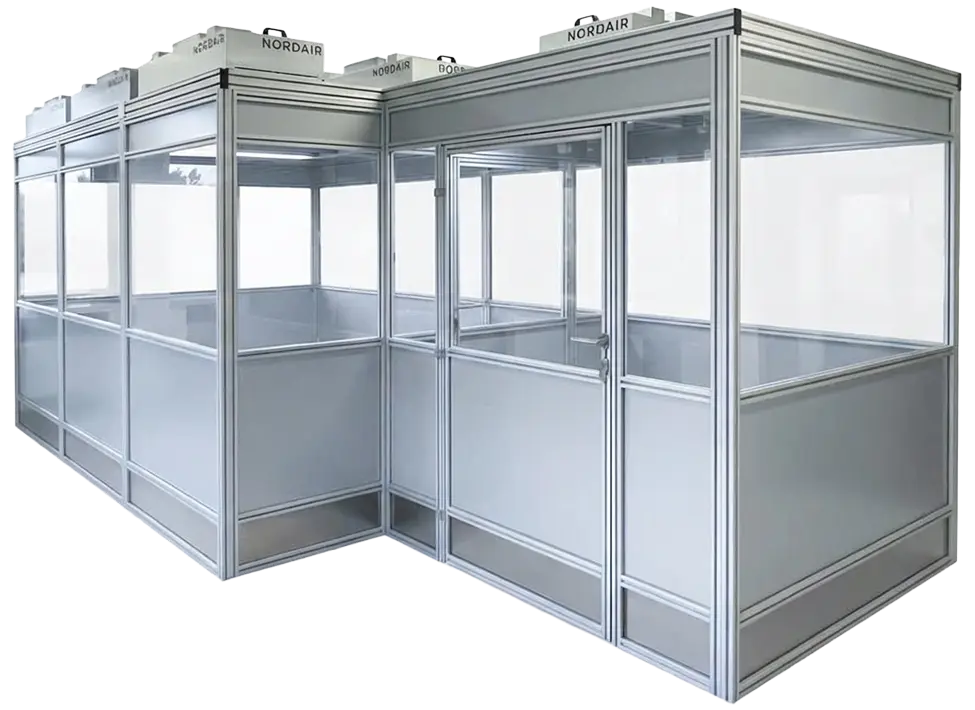
The Nordair cleanroom cabin is geometrically scalable thanks to its aluminum profile system. From 10 m² of starting area, complex process chains can be extended to over 200 m² by seamlessly integrating additional frame modules and filter fan units (FFU) into the existing infrastructure without jeopardizing the integrity of the existing ISO classes.
Geometric scaling possible
In contrast to conventional cleanroom construction (sandwich panels or drywall), which creates static end states, Nordair Systems defines the cleanroom cabin as a dynamic asset. The basis is an aluminum structure with continuous system grooves. This allows a geometric extension of over 200 m² without the need for demolition work. New segments are force-fitted to the existing structure using central connectors. This is essential for growing production lines where downtime due to construction measures is economically unacceptable.
Mechanical decoupling and zoning
Physical enlargement requires an adjustment of the flow mechanics. Since Nordair cabins are decentralized Filter Fan Units (FFUs) use, scales the air output linearly with the area. An extension simply involves installing new FFU grids in the ceiling area of the extension and integrating them electrically. There is no need for complex recalculation of central ventilation systems. This also makes it possible to create different cleanliness zones (e.g. ISO 5 in the core process, ISO 7 in the pre-area) within a coherent cabin structure.
Integration of complex process chains
Modularity is aimed not only at space, but at process logic. Thanks to the flexible wall design, lock systems, material handouts or conveyor belts can be retroactively integrated. In semiconductor manufacturing or photonics, linear process chains can be mapped in which the product slides from one cleanliness zone to the next without leaving the controlled environment.