Can the layout of a cleanroom cabin be individually adapted?

TL;DR

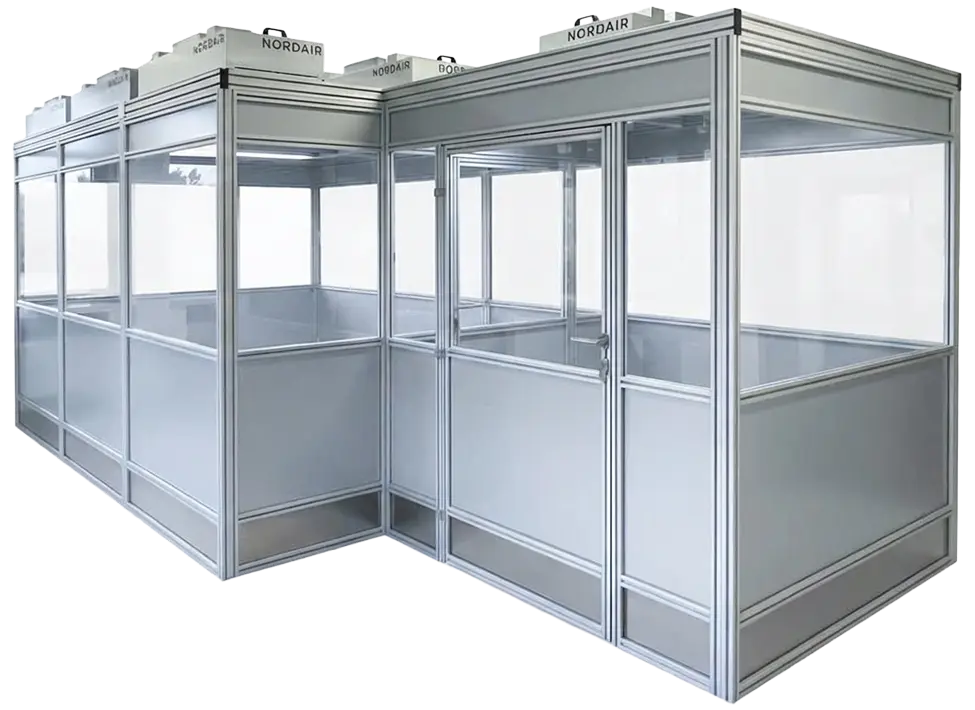
At Nordair Systems, the layout of the cleanroom cabin is completely variable. Since the products are based on sawnable aluminum profiles, they are not bound to rigid grid dimensions. Nordair Systems creates L-shapes, U-shapes or recesses for hall pillars (“interfering contours”) to integrate the cabin into your existing production environment and material flow.

Nordair Systems (Custom Engineering)
Wettbewerb (Standard-Baukasten)
Geometrie-Freiheit
Millimetergenau
(L/U/Z-Formen möglich)
Oft fixes Raster
(z. B. nur alle 100 cm)
Hallen-Integration
Umbauung von Säulen/Rohren möglich
Erfordert oft freie Fläche
(Rechteck)
Höhen-Anpassung
Variabel
(z. B. unter Lüftungskanälen)
Fixe Standardhöhen
Planungs-Basis
Individuelles CAD-Modell
Katalog-Nummer

Freedom vs Grid

In technical reality, production halls are rarely empty. There are support columns, cable lines, ventilation ducts or existing machines. A rigid “catalog grid” (e.g. only 2x2 meter modules) fails here. Nordair Systems uses a parametric engineering model: Since our aluminum profiles are available as 6-meter bars and are cut to the millimetre, we are not bound to fixed grids. We design the cabin geometry exactly around existing interfering contours (e.g. hall supports).

Designed for complex floor plans

The layout of a cleanroom cabin must follow the value stream, not vice versa. If your material flow requires an L-shape or U-shape to convert a machine (“docking”), we adjust the cabin statics accordingly. We integrate:

  • recesses: For conveyor belts or robotic arms that extend into the cabin.
  • Height jumps: Adjustment of the ceiling height for low hall girders or crane tracks.
  • Asymmetric locks: Positioning of material and personnel locks exactly where logistics need them, not where the standard module requires them.

CAD-based collision testing

Before a profile is sawn, our planning team creates a digital 3D model (CAD). This simulates collisions with the hall infrastructure. The result is not an “off-the-shelf kit”, but a statically calculated special construction made from standard components. This keeps costs at series level, but offers the perfect fit for a custom-made product.