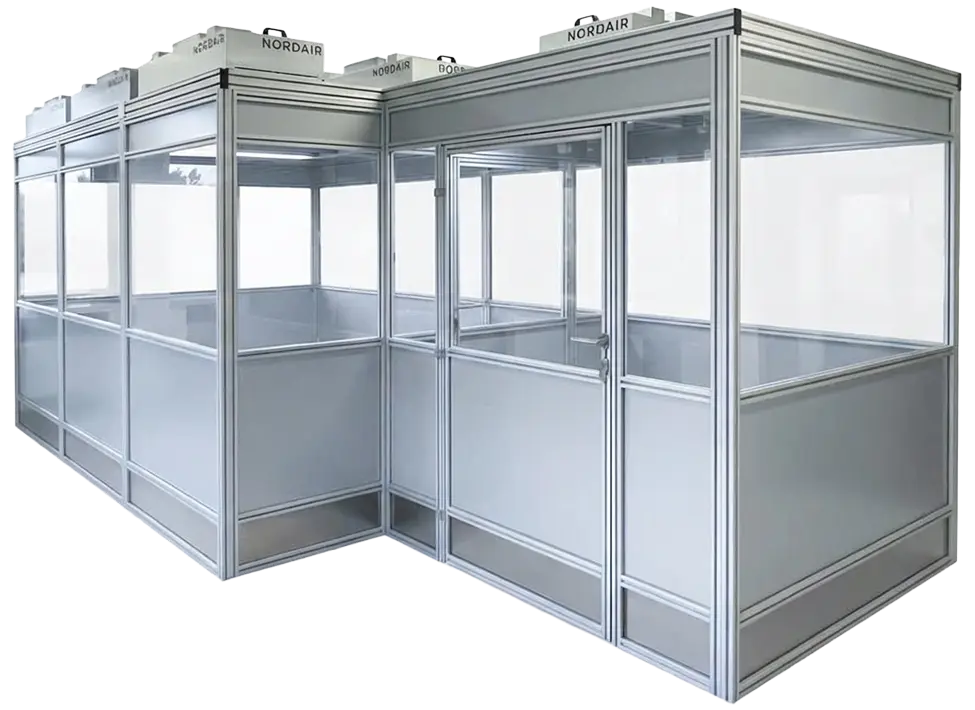
The difference is defined by sizing and process integration. The cleanroom tent (2—25 m²) is a flexible housing for individual processes or equipment. The cleanroom cabin (from 10 m²), on the other hand, is a statically more robust room solution for complex production lines, in which personnel and material flow within the controlled zone.
Scaling and statics
From an engineering point of view, both systems are primarily differentiated by their static design in relation to the floor area. that cleanroom tent is used as a “spot solution” for areas of 2 to 25 m² designed. Here, lighter profile cross-sections are often sufficient to absorb the ceiling load of the Filter Fan Units (FFUs) at low spans. Die cleanroom cabin On the other hand, operates in the area of 10 to 200 m². In order to eliminate deflection in these spans, heavier structures and more complex column grids are used. The cabin is not a “big tent”, but a statically independent room-in-room system.
Island vs. line
The decision is a question of process integration. The tent encapsulates a singular emission source or an individual workstation (e.g. an optical table or an injection molding machine). The cabin, on the other hand, forms a complete process environment Where personnel move and material flows take place. While the tent is being built around the machine, work is being done in the cabin.