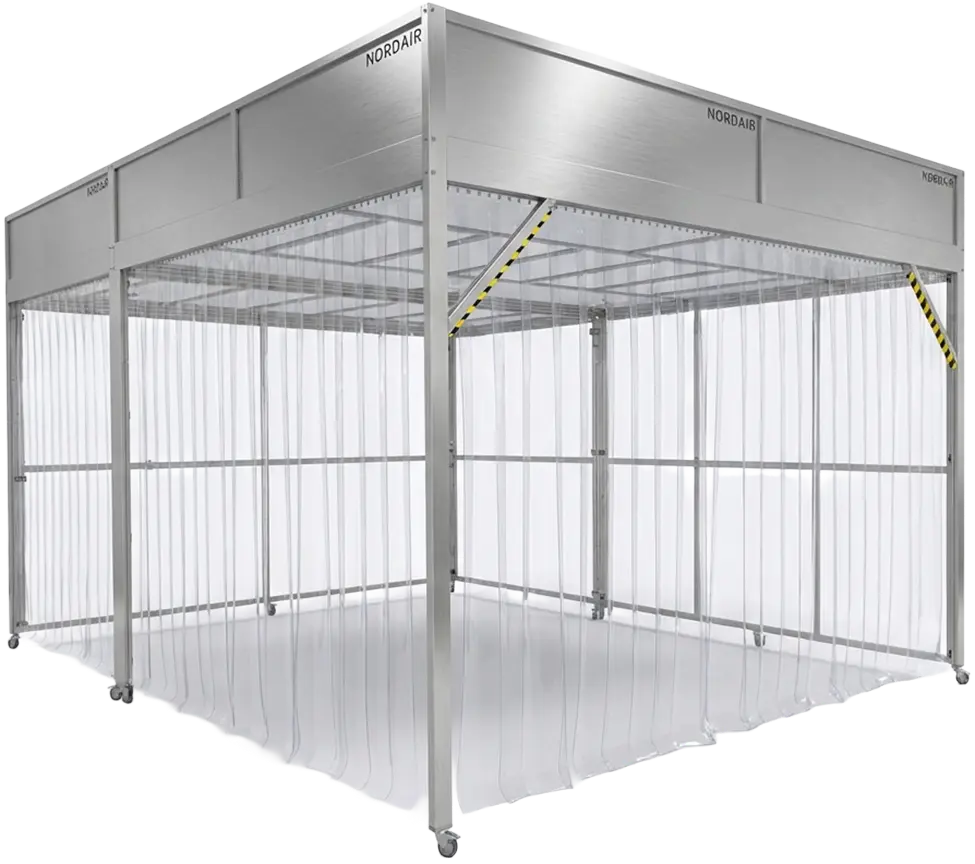
A cleanroom tent based on aluminum profiles can be modularly expanded, as the connection technology (system groove) allows the non-destructive installation of additional segments. By replacing passive ceiling tiles with active filter units (FFUs), the ISO class can also be scaled retrospectively during operation.
Technical basics
The expandability of a clean room depends primarily on the selected substructure. In cleanroom technology, a basic distinction is made between static systems (welded steel frame/drywall) and dynamic systems (aluminum construction profiles).
Mechanics of the system groove
Industrial cleanroom tents are ideally based on anodized aluminum extruded profiles. The technical advantage here lies in the System groove. This allows connections to be produced in a friction-locked manner using groove blocks and central connectors without changing the material through drilling or welding.
- Geometry extension: Additional profile segments can be flanged onto existing supports to increase the floor area.
- Nordair Systems solution: We rely on a 45 mm profile system with high wall thickness. This ensures that the statics are retained during an extension and per meter of profile strut Loads of up to 40 kg can be recorded.
Cleanroom class scaling
A common problem with growing requirements is that particle limits are becoming stricter (e.g. change from ISO 7 to ISO 5).
- The principle: The ISO class is defined by filter occupancy determined in the ceiling grid. The more area is covered with filters, the lower the turbulence and purer the airflow is.
- The implementation: A modular ceiling system uses a grid size in which active filter fan units and passive blind panels have the same dimensions.
- Nordair Systems solution: Our ceiling grids are designed in such a way that blind panels can be removed at any time and replaced with H14 HEPA modules. This makes it possible to upgrade the purity class without structural intervention in the frame.